1. Before the museum

Local scholars were behind the creation of the museum. The commune of Le Grand-Pressigny was not the richest area in terms of remnants; it was, though, home to enthusiastic amateur archaeologists who, at the end of the 19th century, discovered the first evidence of Neolithic stone-cutting-sized workshops. It was, therefore, only natural that they dreamed of having a museum in this village.

Doctor Auguste Léveillé (1805-1880), was the first person to show an interest in the nature and date of the remnants discovered in Le Grand-Pressigny.
The Moizay polissoir stone, called the Léveillépolissoir stone, was the first discovered in Le Grand-Pressigny.

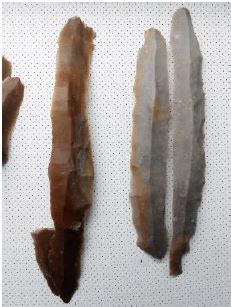
In 1883, the discovery of a deposit of over one hundred blades in Les Ayez, in Barrou, was the first evidence of workshop activity and the expertise of Neolithic stonecutters.
In 1910, the French Prehistoric Congress in Tours brought together the cream of French archaeologists, who made an excursion to Le Grand-Pressigny.
2 The museum in the town hall, 1922
The first museum opened in the town hall premises in 1922. Despite the efforts of many to use the château for this purpose, it would remain here until 1955. The collections, which led to the publication of catalogues, were quickly classified as “Historic monuments”. An association of friends of the museum was created in order to manage the collections, which were placed under the responsibility of a curator. 
Doctor Edmond Chaumier (1853-1931) was behind the first developments in the museum.
The Association of Friends of the Museum of Prehistory of Le Grand-Pressigny was created on the 26th June 1935.

In October 1922, the museum was installed in the town hall and entrusted to Jacques-Marie Rougé, a folklorist writer, keen on prehistory.
An enormous polissoir stone, the Birettestone, entered the château.
3. The museum finally comes to the castle, 1955
Installing the museum in the château took place in stages: the display cases were made in 1952, then public access to the temporarily installed collections on the ground floor of the Renaissance gallery and the development of the upper gallery, with the inauguration in 1955.
The presentation of the collections in the Renaissance gallery.
4. The museum gets a facelift, 1991
At the beginning of the 1990s, the museum was transformed: now more pedagogical, it opened up to recent discoveries. However, only the first phase of a more ambitious project was carried out in full.
Because of their height and width, the display cases are able to use their space to vary the presentation.
5. A new museum outside the casle?
1991’s renovation was just the first section of a larger project. The prospect of dedicating the ground floor of the Renaissance gallery to the extension of the museographical presentation quickly gave way to a new project.
The idea of an underground museum, outside the château, led to architectural outlines that did not meet with the approval of the public powers. Ambitious and costly, this project was also rather unrealistic.
The abandonment of the project caused dismay among local inhabitants and cast doubts on the potential emergence of a significant museum.
6. The museum today
The idea of a new museum was never abandoned, even if its implementation proved difficult.


Preventative excavationhad to becarried out in inconvenient and urgent conditions. | | Restoring the wall decor and fitting the upper gallery with a wooden floor. |
At the end of 2004, the State provided strong support in terms of relaunching the project and, as of 2005, a team was recruited, bringing together an architect, museographer and curator.
The difficulties of running a large building site in a rural area, in a historical monument, with the ambition bringing new spaces in the château to life meant that it was closed to the public for three years.
Developing the Renaissance basements in order to install exhibition rooms there.
Designing a new museography.
To welcome you today: an inspiring adventure.